creative practice, instinctive meditation, journaling, meditation, writing

Meditation as Inner Journaling

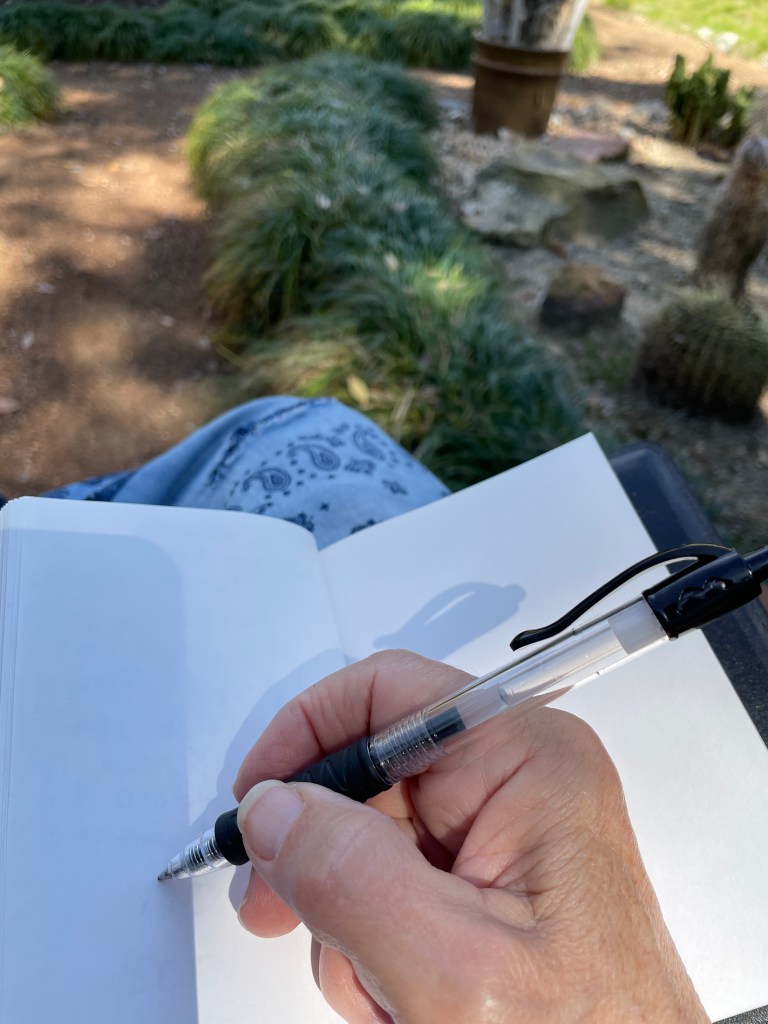
Image show closeup of a hand holding a pen on an open journal with blank pages. In the background is a garden path and plants

Not long ago I was invited to reignite my journaling practice as part of a journey to understand myself more deeply. I balked at first, and decided to meditate awhile to figure out why.

My journals are sacred space, and there have been times that has not been honoured, so I know that’s one reason, even though I currently live alone. Although I’m pretty good at allowing a direct mindheart to pen connection, my inner writer and editor sometimes disrupt the flow… backing up.. crossing out… rearranging. And sometimes seeing my thoughts in writing make them somehow more “real” and a whole different adventure of judgement and evaluation begins.

It came to me that meditation is a form of inner journaling- the ultimate sacred space. I’ve cultivated a practice that welcomes and allows all that comes up, without judgement or editing… sounds a lot like pen to paper or hands to keyboard journaling, doesn’t it?

Opening to a feeling in meditation for me is sometimes less distracting than writing. I can explore more deeply all the nuances that it encompasses… mind.. body… and spirit, beyond words. I can explore in multiple directions simultaneously in a way I have yet to discover while writing. I do often have a pen and paper nearby, for the times I have astonishing realizations. They don’t always stick with my in thought, so this has been working for me, as I flow between inner meditation and outer meditation… inner and outer journaling.

Astonishment doesn’t have to be life-changing, by the way.. it can be as beautiful as recalling in detail some small thing I witnessed in a day… like the dance of shadows on a sidewalk. Becoming more attuned to experiencing awe, wonder, and astonishment is enriching my life so much!

Meditation has also enhanced my writing. If I take even a short bit of time to transition between ordinary and writing states of mind, I’m becoming more able to allow the flow, without distraction, and seeing the act of writing or typing as part of the embodiment of that flow. Much as I learned long ago to hit record from the moment I sit down to compose digital music. I can finesse and edit later- the important thing is being open to receiving what the Muse is whispering to my heart.

art, art appreciation, creative practice, Creativity, inspiration, instinctive meditation, meditation, mindfulness, Personal Development, Personal growth

More Benefits of Arts Participation

Image shoes ways in which arts participation can potentially be beneficial to people and communities: Reduce lonlieness, prevent depression, enhance cognition and mentat function, increase longevity, reduce stress, support success in education, and boost voter participation. Image from One Nation One Project.

I’ve been exploring some of the research that’s out there to support and quantify my intuition about the benefits of creative practice, which can include everything from art appreciation, listening to music, fine arts, crafts, cooking, gardening. If you can think of something that invites you to explore the world with curiosity and see/express things in a way you haven’t before… to me it counts!

One Nation One Project is doing a lot around how art participation is not only beneficial for individuals, but also for communities. Here’s a link to their initiative, which includes the above graphic https://www.onenationoneproject.com/arts-health-connection

It’s interesting to see that many of the benefits from arts participation are also benefits of meditation. I love how meditation and creative practice work in partnership with each other.

You don’t need a lot of fancy supplies to explore creativity. You don’t have to be “good” at European-style art. Create and explore for the joy of it!

I would love to collaborate with you in exploring how creative practice and meditation can enrich your life. Or just one or the other! You can book a free 30-minute curiousity call here https://calendly.com/adelesatori

creative practice, instinctive meditation, journaling, meditation, music, sound therapy, Uncategorized

The Joy of Being an Open-minded Skeptic

This video combines three of my creative practices: music, art, and meditation. I used the often accepted premise of colour and sound associations with the seven main chakras of the human body.

I got to thinking- what is the origin of these associations? I mean- the notes are from a modern Western scale. Even thinking about the chakras themselves. They line up with major endocrine glands, and that makes some sense. Sometimes I think every cell might be a chakra- little galaxies dancing around in the dense formation we call our body. It’s useful to have guides of some sort for visualization. When I’ve worked with people’s energies, I have felt different buzzes of energy rather than colours, and not necessarily where the chakras have been traditionally assigned. After all, the body’s nervous system is bioelectrical, and I’ve often thought just as possible to “leak” as a light switch that’s not wired correctly.

Humans are interesting in to what they give value and meaning. I found information that the association of colours with chakras either began with the Tantric association with the elements, in 1927 from Charles W. Leadbeater’s 1927 book “The Chakras”or in the 1970s with Christopher Hill’s book called “Nuclear Evolution: Discovery of the Rainbow Body”. So colours have become associated by mostly universal agreement.

Sound is another matter. There’s been a bit more study from my short stint of looking, around the effect of sound as a healing tool. Also a lot of claims, and again agreed upon parameters.

There’s no doubt that sound can create the opportunity, a doorway, if you will, for the brain and body’s relaxation response to kick in. And I’ve seen videos of people with Parkinson’s have their tremors decrease dramatically when music, especially favourites of the subject is played.

Music- groups of sounds linked together in a deliberate (even in improvisational music) has been a proven tool for people to access their unconscious mind, express feelings they might not be able to with words (emotionally or physiologically), and connecting with the breath through movement, vocalizations, and breath.

I’m less certain of claims, for example, of a tuning fork or singing bowl of a certain frequency being placed on the body will invoke healing. The vibrations feel good, but I’m not certain of the healing properties. Or laying on a vibroacoustic table (I’d like to try that out! For science!) Other than the mind is a very powerful tool on its own. Plus. Singing bowls have a fundamental tone and multiple overtones, so which is the supposedly healing tone?

I do what I call sound experiences, but I wouldn’t call it sound healing. I create a safe and supportive atmosphere with sound allowing the listener the opportunity to relax and allow the body’s natural instinct to rest and repair to activate. I will sometimes invite participants to sense if they feel a sound in their body, and if and thoughts or associations come up that they’d like to explore.

Sound/music has the potential to invoke a relaxation response- which can include a decrease in blood pressure and theta and delta waves of the brain, but it’s not guaranteed. Sounds one person finds soothing, another may find jarring or creates tension. I personally have trouble feeling relaxed around high pitched notes, ocean drums or white noise.

I’m excited for the research to dive into this intriguing field.