
…and your wisdom will rise up to support you

…and your wisdom will rise up to support you

I was talking with an accountability partner the other day. They were expressing frustration as a leader, when they didn’t how to more effectively approach team members that kept doing the same thing, the same way, and failing.
We’ve all done it at some point. Try the same thing the same way over and over, and fail. Our brains just can’t seem to figure it out. It’s like a dog trying to go through a narrow opening with a long stick.
Perhaps we see a team member or colleague follow the same pattern, with an unsuccessful outcome. As a leader, we make the same suggestion, over and over, and have the same result. We can see so clearly what they should be doing differently, and the desired outcome just doesn’t materialize. We can’t figure out a way to advise the person in a way they will understand.
In either case, there can be the pressure of “I/we don’t have time to fail”, which can add another layer of real and/or perceived obstacles.
When we fail within ourselves, we will sometimes give up in frustration. When failure arises in a group, the outcome of the efforts of the entire team can be affected. A person may end up feeling stigmatized and be less willing to take risks in the future.
As a leader, there is a delicate balance between catching the action in the moment and reestablishing the flow, or risking calling out a person in front of their peers and souring group dynamics. If there’s a potential learning opportunity for the entire group, find a way to reshape the process for the team.
Try brainstorming together. Understanding that people learn in many different ways, this can create a collaboration that accommodates the different styles that works for everyone. It gives space for the team to support and nurture each other’s success.
If it’s more appropriate to work with the person one on one, ask them to describe their process. It could reveal where the glitch is, and how to fix it. It’s important that people feel empowered in their improvement, and not shamed. Talking through their routine can create space for them to have their own aha moment.
One of the benefits of creative practice is you build your failure muscle. That is, you build your willingness to fail in a new way... even courage to fail in a new way. Curiosity and exploration can lead to doing things in ways you hadn’t considered before, and lead to the desired result.
So how can one do this in ordinary, non-creative practice life? It’s a matter of burning new pathways. Our brain has learned a way that doesn’t work, and it stubbornly won’t give it up!
Engage in visualization and/or meditation.
An individual or group can practice visualization, where a process is rehearsed internally, and then apply the new process in real time. Allow all the possibilities to flow through imagination. This combined with brainstorming can encourage innovative thinking and outcomes.
Recall a time you did succeed… either in the actions where you are currently failing, or something completely different. When we succeed, we often can feel it coming, dropping into the zone where everything seems to magically fall into place. Replay those moments in your mind.. how it felt, what you did.. engaging fully with all your senses.
In addition to visualization, meditation practice in general invites a deeper connection to self and the world around us. In Instinctive Meditation®, which I practice, all is welcome. It’s not about blocking things out, but allowing it all to arise, and let the mind do it’s thing.
Do something seemingly unrelated to what you were doing.
In creative practice, I will sometimes work in a different medium- maybe even one I’ve never worked with before. We’ve all sucked at trying something new, until we start to understand the properties of what we’re working with. If you learned to ride a bike, play a musical instrument, or learn a new work procedure, you likely failed a few times before you “got” it.
In a group setting, where practical, cross training might be successful, or even show strengths that weren’t apparent in a different role. This can be another opportunity to involve the whole group in exercises. These could include incorporating movement and rhythm, writing up procedure manuals together, and so on.
Once when I was teaching kids of a broad age range, the littles weren’t getting the concept of weaving. I made up a game, on the spot, where we held hands and wove over and under each other. It helped! My typing teacher (ancient times!) had us imagine a song with good rhythm in our heads to help our typing speed and consistency.
Model the actions of someone you admire.
Who is successful in doing something you’d like to do? Watch successful plays of sport figures, teams, or dancers and try out their moves. What does a speaker, singer, or writer do to warm up? Try out their routines or drills. Set up an interview with someone who is where you want to be, and ask them how they got there.. what their successes and failures have been. Some of the people I admire most have had some pretty spectacular failures. Ask someone to be your mentor. Find an accountability partner.
Don’t take your failures personally.
This can be a tough one, especially for those of us who’ve internalized stories of not meeting the expectations of those who rely on us, or been met with a rejection if we don’t meet high standards. Your self talk might reflect this… “I never… I always… what made me think I could.. ” If you come up against this obstacle, it can be a good time to work with a life guide of some sort. Journaling and meditation can also be useful tools.
Failure is part of being human! It’s how we learn.
You will fail at some things. Remember that you succeed at many more! Failing lets us know we are stretching our capacity to grow. Give yourself permission to fail. This is where deliberate practice of any kind is so important. It allows you to explore without expectation of outcome. To more deeply connect with process and self.
Be willing to have the courage to fail in a new way.
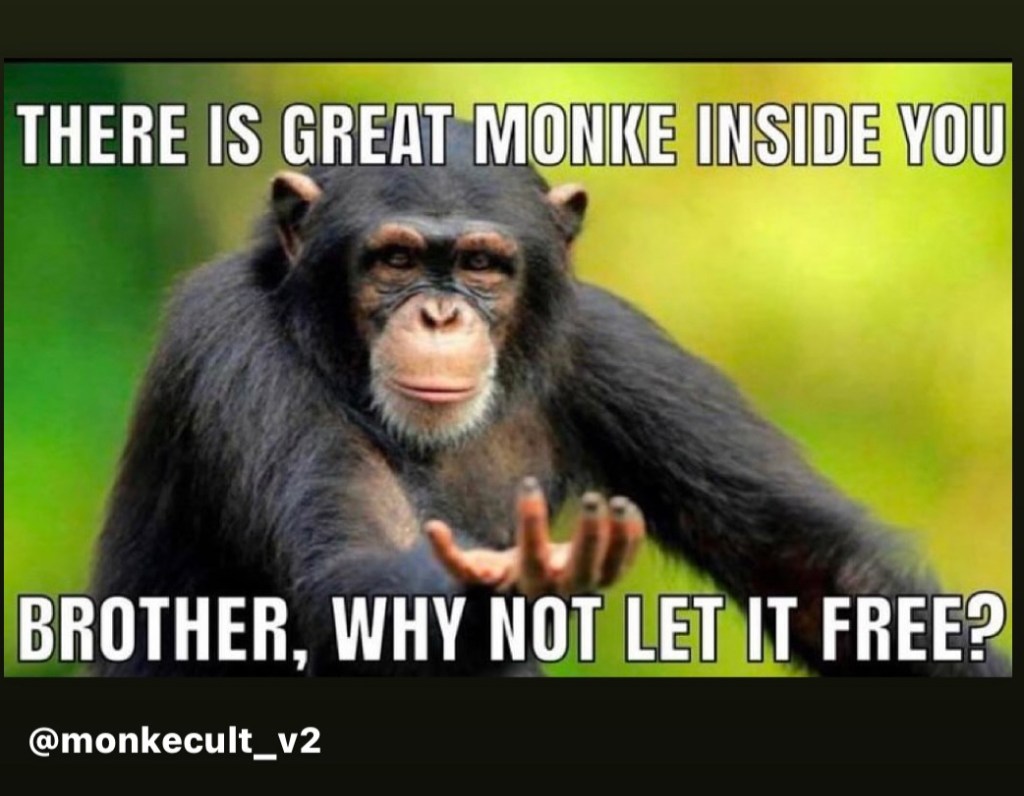
If you’ve every explored meditation, chances are eventually you’ll come across the concept of the monkey mind, and how important it is to quiet it.
I’d like to challenge that. In Instinctive Meditation®, we welcome all aspects of ourselves, and that includes the monkey mind…. those parts of ourself that can be easily distracted, confused, or just continually chatter. Your time spent meditating doesn’t have to be sitting in an uncomfortable position, or attempting to stifle the inner workings of your mind. It’s about allowing the experience to be the experience, and giving yourself permission to simply be.
In modern living, our brains are operating like there are bunch of apps all opened at the same time, or a radio station playing in the background. When we take time to simply be, the volume and presence of that internal chatter comes to the forefront. “Maybe I should have said something differently in that meeting today. What’s for dinner? My nose itches. Haha… that was a funny post I saw- I should send it to my friend”. And like a giggle that might arise at an inopportune time, the more we try to not to have the thought, the larger it becomes.
When thoughts arise in meditation, it’s the brain doing it’s thing. You’ve given your mind space to sort, categorize and repair. It’s a safe place for scenarios to play out. You may feel an urge to jump up and attend to some of these things. I invite you to allow them to flow through, and if they are persistent, take a moment to either acknowledge it’s presence and “tell” it you hear it, and will address it later, jot it down, then continue whatever form of meditation you are doing. I sometimes like to say “Come on, monkeys!! Whatcha got?”
The art of allowing your mind to go on it’s own adventure is a big part of this style of meditation. It’s a natural rhythm of meditation to go in and out of a meditative state, just as our stages of sleep are deeper and lighter. You will come to think, “oh yeah. I’m meditating.” and continue.
I’m here to tell you, it’s going to all be OK, and here are some things that might work for you.
Write it out. Set the beginning time of your practice to do some writing- a writing utensil on actual paper use your brain a bit differently. You can write thoughts, the same word over and over, doodle. There’s just something about the act of writing itself than can be calming. These marking don’t have to be precious. You can make part of your meditation time at the end be to setting these markings free by doing something like tearing them up into tiny bits if you like.
Get silly. Honour that inner monkey, quite literally. If you’re in a place where you’re comfortable to do so, pretend to be a monkey, arms up in the air, lumbering through the room, maybe making monkey noises or giving voice to those thoughts inside your head. Sometimes releasing the energy of those thoughts can encourage them to settle down.
Move. If being silly doesn’t work for you, try putting on some music and dancing for awhile, then lay down and allow the feeling of movement to go inwards. Repeat a few times, ending with laying down and giving yourself permission to rest.
Be curious about your breath. This is a bit different than focusing on your breath, to me. Settle in a comfortable way, and get cozy with your breathing in its natural rhythm. Take time to appreciate the texture of it…. the change in temperature during the inhalation/exhalation cycle. The sound of it. Feel your breath flowing through your body- not just in and out of your lungs, but lighting up and feeding every cell- head to toe. Allow yourself to lose track of your breathing, and drift off. (P.S. falling asleep during your session is OK! Many of us are so sleep deprived!)
Engage with something you love to do. Many of us don’t make time to do something for the joy of it. Is there something you enjoy doing, or used to do, where time seems to fall away? It could be listening fully to music (not doing anything else while the music is playing), digging in your garden, walking unplugged in a less urban environment, creating or appreciating art, tinkering with machines. Try doing this every day, for 20 minutes a day. Even better, twice a day! Give yourself grace for easing into a regular practice.
Explore a pleasant memory. For example, maybe there’s a favourite place you like to go. Call it up in your mind in as great a detail as you can, inviting all of your sensory memories in. How the sunlight felt. The sounds around you. The textures you touch. I find when I do this, my mind settles into a peaceful place.
Use a guided meditation. For the way some people’s minds work, having something to listen to as a doorway into meditation can “short circuit” that chatter and take you deeper. When you lose track of what the guide is saying, IT’S OK! It means you’ve entered into your own version of meditation.
Use an object as a doorway. Instinctive Meditation® calls the ways into meditation doorways. You can use something like a candle, setting up what is for you sacred space, a stone to look at, a houseplant, the pattern of shadow and light coming in through a window. Instead of focusing on it, though, become an explorer. Drink in every detail of the object, engaging all of your senses.
Mantra. Mantra loosely translates from Sanskrit as “mind tool”. In some traditions, it’s a sacred word or phrase, often given to a student by their teacher. Let’s look at it another way! It doesn’t have to be a long phrase in a language you don’t know and feel like you might not remember (although it can be, too!) Repeat a sound over and over that is soothing to you. Maybe it’s “mmmm” or “ahhhhh”. It could also be a short prayer from your existing spiritual practice. Or it could be a word that has meaning for you, or has a quality you’d like to be filled with over the day. Love. Peace. I Am. Sunya. Stretch it out and luxuriate in the sound. Perhaps start by saying it out loud, then whisper, then recite with your inner voice.
Work with a meditation coach. Sometimes it’s helpful to have a coconspirator and witness to your process. A coach can help you explore what you need in a session and become attuned to what you might need on any given day. This can be different each time! One time a walking meditation might be it, another might be a nap, or any of the ideas listed above, and more. You have inside you a wealth of knowledge and doorways into meditation and rest that are unique to you; a good coach can help you find the way.
I would love to collaborate with you in creating your own meditation practice. You can schedule a free 30-minute call here to see if we are a good fit. https://calendly.com/adelesatori
I look forward to exploring with you!

It can sometimes be more of a challenge for me to write on an assigned or chosen topic rather than answer the call the Universe is sending. So what do I do? While getting ready to write this article, I laid in my bed, meditating. Imagining my hands on the cover of my journal. Thinking of all I’ve learned in my training: “What do I love?” “In what quality of life do I want to be immersed?”
Then the neighbour’s illegal chickens started singing their egg laying song. Some people deal with monkey mind; I’ve got chickens. So creative! And I started to laugh.
There are so many parallels between creativity and meditation. Setting up sacred time and place. Distractions. Blocks. Daydreaming. Attuning to our senses, instincts, and intuitions. Finding beauty in the mundane. Thoughts coming faster than the conscious mind can process them.
And what do I do when I feel blocked, or stuck, or having a case of the I-don’t-wannas? I simply start. Doodling in a notebook….. words or lines, it doesn’t matter. Get up and move. Go somewhere less urban and welcome the mountain vista into my heart. I feel myself drop into a meditative state, or a spark of inspiration makes itself known, and I begin to create.
Creative practice and meditation are ways of being in the world where we can gain a deeper connection to Self. Creating and meditating both ask us to be open to what is desired or needed in the moment.
Creativity is bound to our instinct to make meaning. It’s about giving your imagination permission to see, feel, and explore, without judgement or expecting an outcome. A way to express one’s inner world in the outer world. It’s putting things together (this can be objects, concepts, routes, movement and more!) in ways unique to my being. How I am in the moment will be reflected. If there are constraints or requirements, that will challenge me to be innovative in my approach.
In creating for the enjoyment of the process and discovery, something wonderful might be revealed that hadn’t thought of before. Much like Instinctive Meditation®, we welcome all our parts, everything that shows up in a creation session.
Creative practice has been shown to improve memory, expand our ways of thinking and problem solving, and encourage flexibility in our approach to life, both personally and professionally. So can meditation!
Meditating is also a creative act. We can sit and chant a few words that hold meaning for us, walk in the woods and listen to trees, watch the waves and get into the rhythm of the ocean, read a passage of a book and pause to allow the words to wash over our soul.
Meditation is an instinct that gives the brainbody an opportunity to rest, restore, repair, and rehearse in our daily life. To come to a place of relaxed awareness. To become attuned to life’s rhythms. To open our curiosity.
When we allow the meditation or creative session to flow, ideas, feelings and sensations arise that might not have if we were determined to do things in a certain way- the same way- every time.
Through Instinctive Meditation®, I’ve come to appreciate more the rhythm of creativity. It’s increased my capacity to see the world around me, and to touch the deep levels within.
We are organic beings living in a linear world many societies have created. Output, production, and tangible evidence that we’ve done something with our time has become more valued that enjoying creating for its own sake. Creativity and meditation are states of being, rather than states of doing. Let your mind show you the adventure of the moment.

I’ve been savouring this first stanza of Sutra 85, from “The Radiance Sutras” by Lorin Roche, PhD.
In trying something new, or even a fresh day, one can open one’s Self up to so much if an encounter, exploration, or a routine you’ve done a thousand time, is approached without layering expectations over the experience. I learn so much when I engage with something as if it is for the first time. Some of my best work has come when I haven’t been quite certain of what I am doing, and have the willingness to follow where events are leading me.
Here is the sutra in its entirety:
Toss aside your map of the world,
All your beliefs and constructs.
Dare the wild unknow.
Here in this terrifying freedom,
Naked before the universe,
Commune with the One
Who knows everything from the inside:
Invisible power pervading everywhere
Divine presence permeating everything.
Breathe tenderly as
The lover of all beings.
 craftingthespirit.com