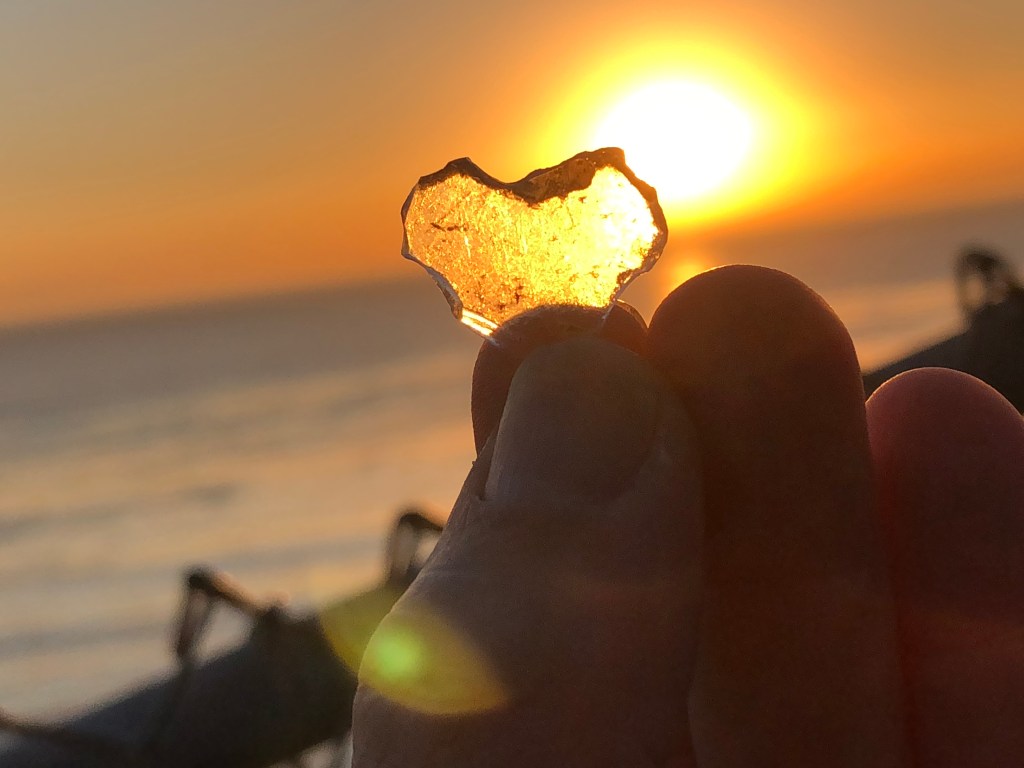
Image is a color photography of a hand holding a heart-shaped piece of clear glass in front of a sunset by the ocean.
What sacred treasure lies in the hidden places of your heart? ***************************** There is a secret temple in your heart, longing to be discovered. Pulsing in and around you always.
Curiosity and courage are map and key. Open the door and greet your Self.
Invite the beauty of existence to fill you with its light radiating everywhere, until the Truth of Universe and Self as One bursts through the temple walls.
Sings it song for all to hear, Or whispers just to you. Calling you to dance, and laugh, or to rest awhile in quiet splendor. ~Adele Satori, 14 March 2026
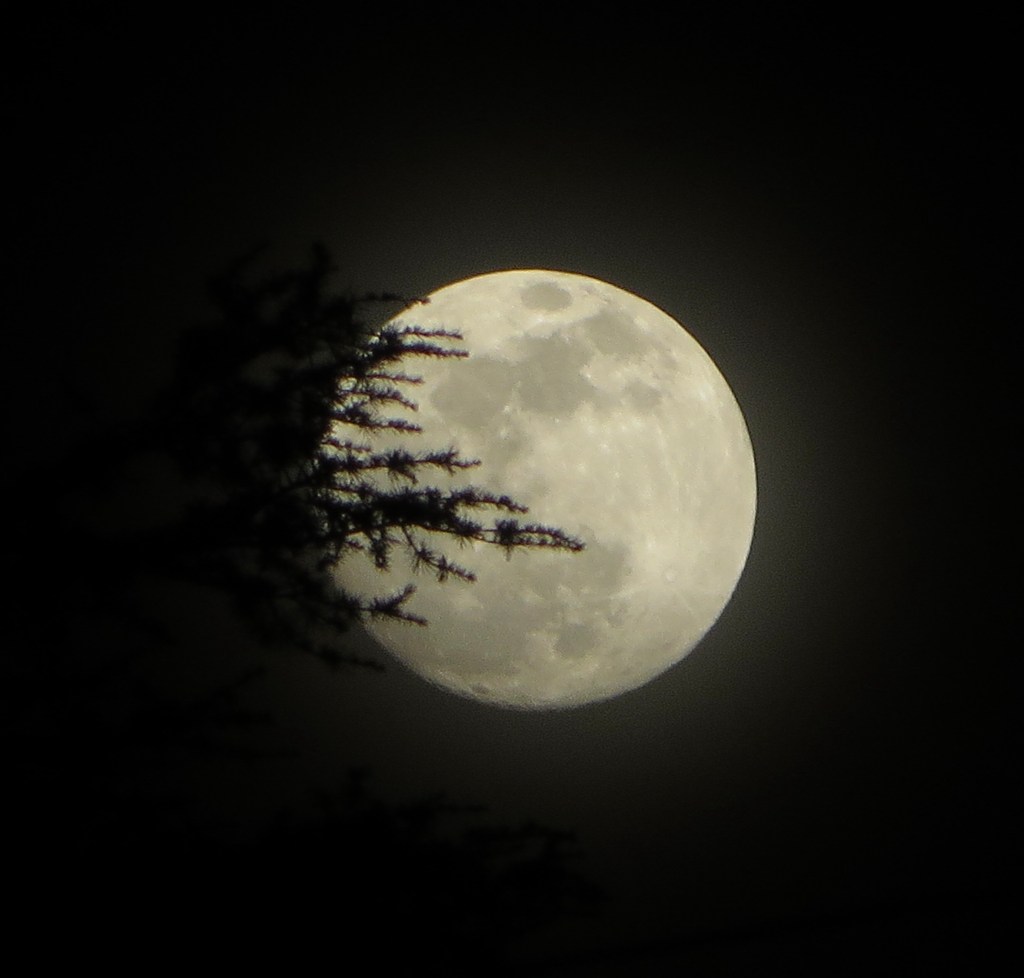
Image is a black and white photo of the full moon with pine branches reaching across from the left side
This morning I woke up, thinking about today’s first full moon of the year. How in some traditions the full moon has been seen as the culmination of events, and a time to release that which no longer serves us.
I started to wonder, instead, of thinking of the full moon, and all of the phases of the moon, as a ripening, and reaching up to pluck it like a sweet berry from the sky, full of starlight and dreams. Inspiration and a seed for the coming month. A reminder of the continual cycle of growth and rest.
I love shifting and exploring different perspectives. It’s part of my creative practice.
May curiosity and awe continue to lead each and everyone of us into exploring the beauty and possibility all around us.
Image is a black and white photograph of a light coloured piece of crumpled paper on a black background
Time spent in creative practice doesn’t have to result in something tangible.
Not one word, brushstroke, note, pixel, movement or sound needs to exist.
How did reading that make you feel? Excited? Uncomfortable? An exclamation of wow, or how ridiculous?
Congratulations! You just did something creative! You received an external stimulus, processed it, and put things together that is an expression of all your experience in a way that is unique to you. A definition of creativity.
I teach a creativity and meditation class once a month. One of the cool things about that is that I either come up with a theme and explore it, to see how I might invite others in the creative practice portion of the class, or I mess around with one of the many ways I like to engage with the world, and see what comes up.
Something that arose for me this month is that there doesn’t have to be a tangible result during time spent in creative practice. I think that’s what holds some people back in exploring- the pressure to make something that’s visible to others… or something that has some perceived value. Comparing it to work that’s in a gallery/museum/stage/musical platform/book.
How would it be for you to instead take a walk with a theme, such as “what colour/shape/sound am I most noticing today?” Or sit somewhere and become immersed with the music of life flowing around you? Spend time in your creative space (even if it’s wherever you make a place in the moment) and explore your materials with your senses? Feel the textures of paper, metal, wood, or beads in your hand. The squish of garden dirt between your fingers. The weight of a musical instrument on your lap. Laying on the floor and feeling the subtle energy of breath and blood pulsing through your body. Watch the quality of light and shadow shift with the passing of time. Listen to music and follow the sound of one instrument. Enjoy it in the moment, and set it free.
All of this, to me, is both creative practice and meditation. I won’t have anything to show for it, but it’s tucked away in my mind and heart, and time has revealed that these things appear at some point later, when I’m in the flow of creating something in my outer world. And something I can revisit at any time I choose.
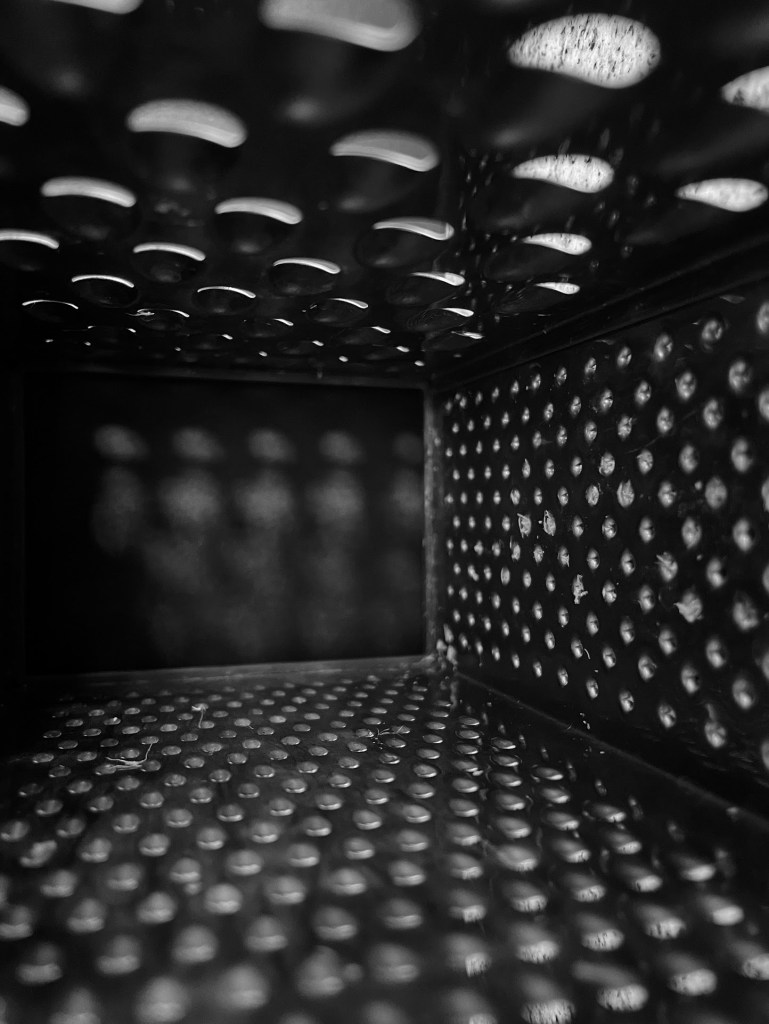
The picture at the beginning of this article was part of my most recent exploration. My theme in November started as light and dark, and expanded to exploring opposites. Earlier in the day I had taken some photos of the interior of a box grater, and had been thinking about light and shadow most of the day.
Image is a black and white photo of the interior of a box grater
I crumpled up part of a brown paper bag and set it on my table. I started to sketch it- white chalk on black paper, and became a little frustrated. Drawing has been problematic for me over the years, for so many reasons (an article in itself!), and I stopped.
Black and white photo of a close up of a crumpled paper bag.
Instead, I gave over to exploring with my senses only. At first crumpling and uncrumpling the paper. I listened to the sounds it made. I followed the folds with my eyes, enjoying the rhythms that appeared. I thought about how I would embody crumpling.. folding and unfolding.. light and dark. I put the paper in different light and noticed how it accentuated different crevices. Smelled that unique brown paper bag smell. When I felt I was done, and only then, I took out my phone and took some pictures. And only because I was inspired to do so. No obligation. No expectation.
Black and white photo of a crumpled paper bag set on its edge on a black background. Black and white photo of a crumpled paper bag on a black background. The foreground is in focus, softening as the image goes back.
I then went on with my day. I loved the sensation that I’d done something pleasurable for awhile, for myself (even though it was initially in preparation for a class).
It’s important to remember that play and rest are integral parts of both creative practice and meditation. Often after an intense round of output, I can spend weeks of not creating any actual thing, but that doesn’t mean than I’m not engaged in creative practice. Rest is a great tool for creativity.
I invite you to play and not create something tangible at the end. Arrange some twigs in a pleasing manner. Stack stones. Make hand shadows. Allow the silliest sounds you’ve every heard come from you. Dance with the wind. Deeply listen to music. Follow the brushstrokes of a painting in a gallery with your eyes. Don’t document it.. simple play and enjoy some unbounded creativity. Do it for you!
Image shows the word FAILED, with a rectangular border, at an angle. Both word and border are red.
I was talking with an accountability partner the other day. They were expressing frustration as a leader, when they didn’t how to more effectively approach team members that kept doing the same thing, the same way, and failing.
We’ve all done it at some point. Try the same thing the same way over and over, and fail. Our brains just can’t seem to figure it out. It’s like a dog trying to go through a narrow opening with a long stick.
Perhaps we see a team member or colleague follow the same pattern, with an unsuccessful outcome. As a leader, we make the same suggestion, over and over, and have the same result. We can see so clearly what they should be doing differently, and the desired outcome just doesn’t materialize. We can’t figure out a way to advise the person in a way they will understand.
In either case, there can be the pressure of “I/we don’t have time to fail”, which can add another layer of real and/or perceived obstacles.
When we fail within ourselves, we will sometimes give up in frustration. When failure arises in a group, the outcome of the efforts of the entire team can be affected. A person may end up feeling stigmatized and be less willing to take risks in the future.
As a leader, there is a delicate balance between catching the action in the moment and reestablishing the flow, or risking calling out a person in front of their peers and souring group dynamics. If there’s a potential learning opportunity for the entire group, find a way to reshape the process for the team.
Try brainstorming together. Understanding that people learn in many different ways, this can create a collaboration that accommodates the different styles that works for everyone. It gives space for the team to support and nurture each other’s success.
If it’s more appropriate to work with the person one on one, ask them to describe their process. It could reveal where the glitch is, and how to fix it. It’s important that people feel empowered in their improvement, and not shamed. Talking through their routine can create space for them to have their own aha moment.
One of the benefits of creative practice is you build your failure muscle. That is, you build your willingness to fail in a new way... even courage to fail in a new way. Curiosity and exploration can lead to doing things in ways you hadn’t considered before, and lead to the desired result.
So how can one do this in ordinary, non-creative practice life? It’s a matter of burning new pathways. Our brain has learned a way that doesn’t work, and it stubbornly won’t give it up!
Engage in visualizationand/or meditation. An individual or group can practice visualization, where a process is rehearsed internally, and then apply the new process in real time. Allow all the possibilities to flow through imagination. This combined with brainstorming can encourage innovative thinking and outcomes.
Recall a time you did succeed… either in the actions where you are currently failing, or something completely different. When we succeed, we often can feel it coming, dropping into the zone where everything seems to magically fall into place. Replay those moments in your mind.. how it felt, what you did.. engaging fully with all your senses.
In addition to visualization, meditation practice in general invites a deeper connection to self and the world around us. In Instinctive Meditation®, which I practice, all is welcome. It’s not about blocking things out, but allowing it all to arise, and let the mind do it’s thing.
Do something seemingly unrelated to what you were doing. In creative practice, I will sometimes work in a different medium- maybe even one I’ve never worked with before. We’ve all sucked at trying something new, until we start to understand the properties of what we’re working with. If you learned to ride a bike, play a musical instrument, or learn a new work procedure, you likely failed a few times before you “got” it.
In a group setting, where practical, cross training might be successful, or even show strengths that weren’t apparent in a different role. This can be another opportunity to involve the whole group in exercises. These could include incorporating movement and rhythm, writing up procedure manuals together, and so on.
Once when I was teaching kids of a broad age range, the littles weren’t getting the concept of weaving. I made up a game, on the spot, where we held hands and wove over and under each other. It helped! My typing teacher (ancient times!) had us imagine a song with good rhythm in our heads to help our typing speed and consistency.
Model the actions of someone you admire. Who is successful in doing something you’d like to do? Watch successful plays of sport figures, teams, or dancers and try out their moves. What does a speaker, singer, or writer do to warm up? Try out their routines or drills. Set up an interview with someone who is where you want to be, and ask them how they got there.. what their successes and failures have been. Some of the people I admire most have had some pretty spectacular failures. Ask someone to be your mentor. Find an accountability partner.
Don’t take your failures personally. This can be a tough one, especially for those of us who’ve internalized stories of not meeting the expectations of those who rely on us, or been met with a rejection if we don’t meet high standards. Your self talk might reflect this… “I never… I always… what made me think I could.. ” If you come up against this obstacle, it can be a good time to work with a life guide of some sort. Journaling and meditation can also be useful tools.
Failure is part of being human! It’s how we learn. You will fail at some things. Remember that you succeed at many more! Failing lets us know we are stretching our capacity to grow. Give yourself permission to fail. This is where deliberate practice of any kind is so important. It allows you to explore without expectation of outcome. To more deeply connect with process and self.
Be willing to have the courage to fail in a new way.
“Some Trees are Blue” Adele Satori 2025. Image shows a textured painting in vibrant hues of blue, orange, red, green, and yellow.
One recent night my memories woke me up.
“Remember the time you painted the trees blue?”
I surely did! I was about six years old, in first grade. I remember being in school, painting a picture of the most beautiful tree. Not only blue, but with yellow, orange, red, and green.
My teacher, who I remember as mostly kind, looked at the picture and told me trees are brown, or black- not these bright colours.
I was heartbroken, and I knew she was wrong. You see, one of the things my family did growing up was to do things like to to museums. I remember seeing the paintings of Paul Gauguin, and being so excited! Here, in a museum, where people came to look at pictures people made, were paintings of trees and plants the way **I** saw them! Bright colours, and vibrating. Here was a grown-up who also saw the songs of trees, and he painted them to show the world.
I may have tried to tell the teacher that. I can’t quite remember; it was a long time ago. I just remember being sad and confused. Didn’t everyone see the songs of trees? How they sometimes shimmer the way pavement does on a hot summer day?
I think most kids have this ability to see multiple realities– until it’s taught out of us. Those of us who somehow keep the magic become the artists, poets, explorers, inventors, often getting “lost” in our beautiful inner worlds. Some of us are seen as mad (I always wondered about that description.).. I suppose the adult version of having a note pinned on our sweaters.
As I lay there in bed, other childhood memories came. That same year, we had a class where the visiting Phys. Ed. teacher put on music and told us to pretend we were a train. We got into a milk-and-cookie infused samba line and chugga chugga’d to the music.
Except me.
Oh no! In my mind I became a train! CHUGGA CHUGGA!!!! WOOO WOOO!!! WOOO WOOO!!! I pumped my arms, shook my head, and in my imagination saw the “more powerful from a locomotive” from the opening sequence of “The Adventures of Super Man” (Starring Georrrrrrge Reeeeves!!!).
Everything, and everyone stopped.
I got taken out of class, and sent home with a note pinned to my sweater about how I couldn’t control myself. It wouldn’t be the last time! So many kidhood memories of experiencing things like this, and “weren’t real”, but those are stories for another time.
My thoughts turned back to trees. Part of me wanted to jump up then and there and paint, but my logical brain started to wake up…. I only have black canvas board… I don’t know where my palette knives are (because this urge was too primal for brushes)… and wandered through the technical aspects of how adult me would paint those trees.
I ended up later that morning going to sit near trees, and soaking in all their textures and colours. I came home, found my knives, and sat down to paint. I went quickly, and intuitively. Sometimes my eyes were nearly closed. I followed the memories of texture, light, sound, and movement. Not thinking if I was doing it right (I’m not a painter, primarily.. I just have the tools around). Not thinking of how others would perceive it. Not worrying if I was wasting materials (another childhood lesson). Simply enjoying the process of painting a tree in all its hidden colours.
And I’m here to tell you… that experience healed something in me. That’s the beauty of creative practice. Creating to create and explore, without expectation of outcome, or demands for others, opens the way to our inner worlds. You don’t have to show it to anyone else, or even keep it.
My invitation to you now, is to remember something you used to do, or like to do and haven’t made the time to do, but especially something you liked to do as a child. Sing silly songs as you go through your day. Make little cabins for ants out of twigs. Finger paint (paint with water on the sidewalk if you don’t have paint!). Twirl in circles. Lay on the grass and watch the cloud beings chase each other. Use what you have on hand. Play and create for the pure pleasure of it.
I’m going to go smile at the most beautiful blue tree I painted.






 craftingthespirit.com